Screen Fatigue
Extended monitor sessions create eye strain and reduce concentration span. Visual rest breaks can help restore clarity and reduce accumulated tension.
Very common
Structured micro-routines designed for office environments. Short, purposeful resets that fit between tasks — no equipment, no disruption, just clarity.
Recognising recurring pressure points is the first step toward working with more ease.
Extended monitor sessions create eye strain and reduce concentration span. Visual rest breaks can help restore clarity and reduce accumulated tension.
Staying seated for long stretches restricts circulation and leads to tension in the lower back, shoulders, and neck. Short movement intervals can help you feel more comfortable.
Switching between tasks, messages, and meetings without recovery time depletes cognitive resources. Structured pauses help restore attentional capacity.
Under sustained cognitive load, breathing naturally becomes more shallow. This subtle pattern can increase physical tension over the course of a workday.
Approaching deadlines trigger a narrowed focus that can cause physical tension. Brief resets between work blocks prevent this from accumulating.
Background noise in shared workspaces demands extra cognitive effort to filter. Even quiet decompression moments may help you reset.
Each routine is designed to fit naturally into the gaps of a standard workday — no extra time required.
A compact sequence for between-task transitions. Clears accumulated tension from the shoulders, wrists, and jaw.
Shoulder rolls — 5 forward, 5 back
Jaw release — gently open and close
Wrist rotations — 10 seconds each
One slow, full exhale
Designed for after extended monitor sessions. May help ease visual fatigue and support focus clarity.
Look at a point 6 metres away for 20 seconds
Slow blink — 10 deliberate blinks
Gentle eye circles — 30 seconds
Palming — cover eyes, breathe slowly for 1 min
A structured breathing pattern that may support mental clarity and ease tension during high-demand work periods.
Sit with feet flat, spine upright
Inhale for 4 counts, hold for 4
Exhale for 4 counts, hold for 4
Repeat for 3 minutes
Targets the most common areas of accumulated tension for desk workers. Can be done seated without leaving your workspace.
Slow neck tilt — ear to shoulder, hold 20 sec each side
Chin tucks — 10 repetitions
Chest opener — clasp hands behind back
Seated spinal twist — 30 seconds each side
A standing routine for when you need to interrupt a long stationary period and restore circulation without leaving your floor.
Stand and shift weight slowly side to side
Calf raises — 15 slow repetitions
Hip circles — 10 each direction
A closing routine to help mark the boundary between work mode and personal time — useful for those working from home or late shifts.
Write 3 tasks completed today
Clear your desk or close all work tabs
2 minutes of slow, open-eye breathing
Brief walk — even just to the kitchen
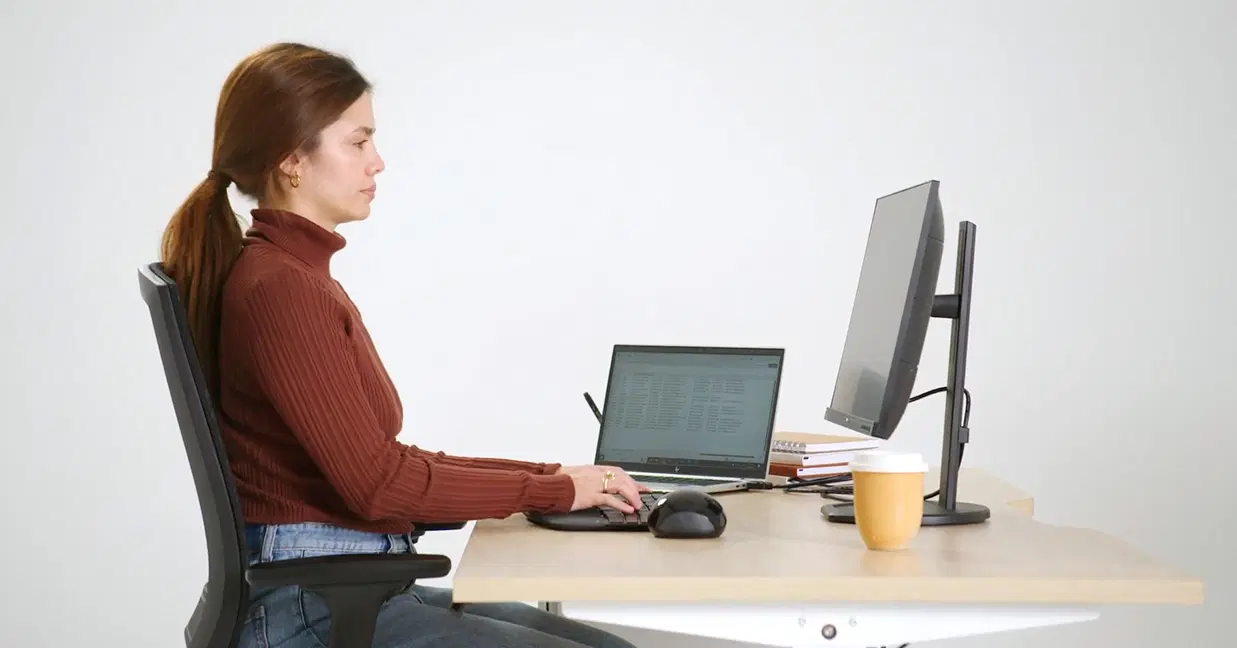
Small adjustments to your workspace and sitting habits may help ease physical tension over a full workday.
Position your monitor at arm's length (50–70 cm), with the top edge at or slightly below eye level to reduce neck strain.
Adjust your chair so hips are level with or slightly above knees, feet resting flat on the floor or a footrest.
Keep wrists in a neutral, level position when typing. Avoid resting wrists on a hard surface during active use.
Position your screen perpendicular to windows to avoid glare. Use diffuse ambient lighting rather than bright overhead lights.
Intentional breathing patterns are a simple way to pause and reset when you feel tense during the day.
Equal-duration cycles create a calming, symmetrical rhythm. Useful before demanding tasks or after interruptions.
A longer exhale than inhale is often used to support relaxation. Helpful for mid-afternoon tension.
Redirecting breath into the diaphragm reduces the shallow chest breathing pattern common during focused work.
Spreading reset moments throughout the day prevents the end-of-day overload that comes from working without natural pauses.
50–60 minute focused periods followed by a 5–10 minute reset keep energy more consistent than marathon sessions.
Leave a short buffer between back-to-back meetings. Even 5 minutes helps the mind shift context more smoothly.
Keeping water at your desk and drinking regularly creates a natural pause habit that also supports energy levels.
Setting a short reminder every hour makes reset moments intentional rather than forgotten until end-of-day exhaustion.
Common workplace patterns and the kinds of micro-routines that tend to be most relevant in each context.
Without a physical transition between home and work, the workday tends to blur at both ends. End-of-day routines and space rituals help create a psychological boundary.
See routinesOpen offices demand continuous sensory filtering. Brief breathing resets and clear task-switching habits reduce the mental load of shared environments.
See routinesExtended video call sequences are more cognitively demanding than in-person equivalents. 3-minute resets between calls may help ease cumulative fatigue.
Desk guideSustained concentration builds physical tension gradually. Scheduled micro-breaks maintain quality over multi-hour work sessions without breaking flow entirely.
Desk guide